Online Dating Statistics South Africa 2026: The Real Numbers
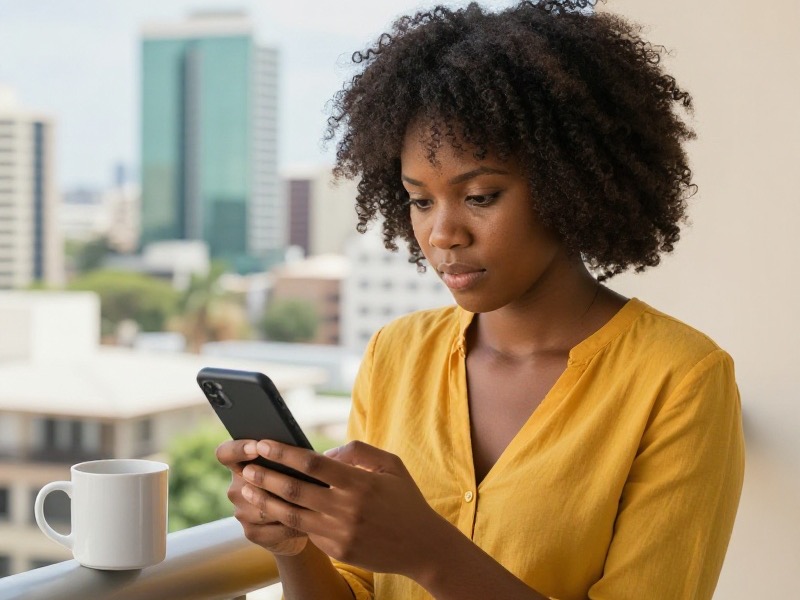
How many South Africans are actually online in 2026?
Roughly three quarters of the country is now online, which is the single biggest reason dating apps work here at all. DataReportal's South Africa report (2025) put internet users at around 45 million people, with social media identities in the mid-twenty millions, on a population of just over 63 million.
The more revealing number comes from Stats SA. Its General Household Survey (2024) found that close to eight in ten households had at least one member accessing the internet somewhere, yet only a small minority had a fixed connection at home. Almost all of that access runs through a phone.
That one detail shapes everything else in this article. South African online dating is a mobile activity from start to finish, paid for by the megabyte, usually on prepaid. Every design choice that assumes cheap uncapped fibre, autoplay video, high-resolution photo grids, endless voice notes, quietly costs local users real money.
How many South Africans use dating apps?
A few million South Africans use dating apps at least occasionally, which is a small slice of the 45 million people online but a large enough pool to matter in any decent-sized city. Statista's tracking of the local online dating segment (2025) shows steady user growth and market revenue in the tens of millions of dollars a year.
Penetration still sits in single-digit percentages of the total population, well behind the United States or Western Europe. That gap is not about interest. It is about cost, data literacy and the fact that a large share of the population is under 20 or over 60, outside the core dating-app age band.
For you as a user, the practical reading is this. In Durban or Pietermaritzburg you will see enough new profiles to keep an app worth opening. In a small Free State town, the same app can feel empty within a week, and widening your distance filter matters more than any profile trick.
Does the cost of mobile data change how South Africans date online?
Yes, more than in almost any other market. ICASA's sector reporting (2025) has tracked a substantial fall in prepaid data prices since the 2019 pricing intervention, but a gigabyte still costs a meaningful share of a low monthly income, and small bundles remain far more expensive per megabyte than large ones.
That pricing shape creates a quiet penalty for the people with the least money. Buying a 50 MB daily bundle repeatedly costs several times more per megabyte than a monthly gigabyte, so the users who can only afford small top-ups pay the highest effective rate for the same conversation.
| Dating activity | Rough data use | What it means |
|---|---|---|
| Ten minutes of swiping | About 5 to 15 MB | Profile photos are the real cost, not the app itself |
| One hundred text messages | Well under 1 MB | Effectively free, chat as much as you like |
| Twenty photos sent or received | Around 20 to 60 MB | Compress or wait for Wi-Fi where you can |
| Ten-minute voice call over data | About 5 to 10 MB | Cheap, and far more telling than text |
| Ten-minute video call | Roughly 50 to 150 MB | The single most expensive safety step you will take |
Read that table again with safety in mind. The one action security researchers recommend most, a short video call before meeting, is also the one that eats a bundle fastest. Plan it: connect to Wi-Fi at a mall, a campus or a library, or use a night-owl bundle, and keep it to five minutes. Text-light platforms help too, which is part of why messaging-based options such as the free DateWiz dating bot on Telegram suit prepaid users, since browsing profiles inside a chat app costs a fraction of a video-heavy feed.
What does the urban and rural divide look like?
The gap is wide and it is about connection quality, not desire. Stats SA (2024) recorded home internet access concentrated heavily in metropolitan municipalities, while households in largely rural provinces such as the Eastern Cape and Limpopo depend almost entirely on mobile phones and shared devices.
Dating apps translate that gap into pool density. In Durban, Gqeberha or East London you might see hundreds of profiles within twenty kilometres. Around Bloemfontein the same radius returns a fraction of that, and in deep rural districts you may need to stretch to sixty or eighty kilometres before the feed refreshes properly.
There is a second, less obvious effect. Long distances plus expensive transport mean the first meeting is a bigger commitment for rural daters, so conversations tend to run longer before anyone suggests coffee. If you are dating outside a metro, budget more time in the chat stage and treat a video call as the checkpoint that replaces a casual, low-cost first date.
Which age groups dominate South African dating apps?
The 25 to 34 band dominates, followed by 18 to 24, with the 35 to 49 group growing fastest. DataReportal (2025) notes South Africa's median age sits in the high twenties, which is young by global standards and explains why the core dating cohort is unusually large relative to the total online population.
Gender balance leans male on most mainstream apps, commonly around two men for every woman. GWI's global tracking (2025) has found the same skew across most markets, along with a consistent pattern: women receive far more first messages than they can reasonably answer, while men see low reply rates and blame themselves for it.
What that skew means for your inbox
If you are a man, volume is not your lever. Ten well-aimed messages referencing something specific in a profile will beat a hundred copied greetings, because the competition you face is other generic openers. If you are a woman, the work is filtering rather than attracting, and a clear, slightly specific bio does more filtering for you than anything else on the profile.
Why do WhatsApp and Telegram dominate the chatting stage?
Because that is where South Africans already live online. DataReportal (2025) consistently ranks WhatsApp as the most-used platform in the country, reaching the overwhelming majority of internet users, with Telegram holding a smaller but growing share, particularly among younger and more privacy-conscious users.
The result is that matches rarely stay inside a dating app for long. Within a few days most conversations move to a messenger, partly out of habit and partly because messaging apps are lighter on data than image-heavy dating feeds. Some networks even zero-rate or discount messaging traffic, which nudges the same behaviour further.
The trade-off is worth naming. Once you move off a dating platform you lose its reporting tools, its block function and any moderation history, which matters if things turn unpleasant later. Move when the conversation has genuinely earned it, and avoid handing over a phone number on day one. Options that live inside the messenger itself, like the free DateWiz bot on Telegram, sidestep part of that problem, since a chat only opens after both people have liked each other and your number stays hidden.
How much are South Africans losing to romance scams?
Losses run into the millions of rands a year, and the true figure is certainly higher than anything reported. SABRIC's digital banking crime reporting (2025) has repeatedly identified social engineering, convincing a victim to authorise a payment themselves, as the leading driver of digital fraud, and romance scams are a textbook version of exactly that.
SAPS guidance (2025) encourages victims to open a case rather than stay quiet, and to report the moment money has moved instead of waiting for the story to unravel further. Speed genuinely matters. A payment flagged within hours has a far better chance of being stopped than one reported a week later.
Kaspersky and Norton research into online dating threats (2025) describes the same escalation pattern worldwide: fast affection, a refusal to appear on video, a crisis story, then a request for money framed as a temporary favour. The AI element has raised the difficulty considerably, since generated profile photos and fluent, tireless chat have removed the clumsy grammar that used to give scammers away.
The three numbers worth remembering
Zero is how many times you should send money to someone you have never met in person. One is the number of short video calls it usually takes to expose a fake profile. Fourteen is a sensible maximum number of days to spend chatting before either meeting somewhere public or letting the conversation go.
What do the safety numbers say about meeting in person?
The overwhelming majority of first dates pass without incident, and the risk that does exist clusters around a handful of avoidable behaviours rather than around online dating itself. SAPS crime statistics (2025) show contact crime remains a serious national concern, which makes the location and timing of a first meeting a genuine decision, not an anxious formality.
The practical rules are unglamorous and they work. Meet in daylight, in a busy public place near your own area, in a mall or a café rather than a quiet park. Arrange your own transport both ways so you never depend on a stranger to get home. Send a friend the person's profile, name and the venue before you leave, and agree on a check-in time.
Two extra habits close most of the remaining gap. Keep your home address, workplace and children's school off the conversation until trust has genuinely been earned, and never let a first meeting move to a private residence, no matter how well the coffee went. If a match pressures you on either point, that pressure is the information you needed.
What should you do with all these numbers?
Taken together, the picture is encouraging with one honest caveat. DataReportal (2025) and Stats SA (2024) confirm that almost everyone who wants to date online in South Africa can now reach a platform, but ICASA's pricing data (2025) shows the cost of doing it well still falls unevenly across the country.
So spend your effort where the data says it pays. One good photo taken in natural light outdoors will outperform six dim selfies. A specific bio line filters better than a list of adjectives. A five-minute video call over Wi-Fi is the cheapest safety measure available to you, and the single best test of whether a profile is real.
The last number is the one no report publishes: how many people quit after a fortnight. Most disappointment with online dating in South Africa comes from expecting it to work at the speed of online shopping rather than the speed of meeting people. Give it three months of light, regular effort, protect your data bundle and your personal details, and your own statistics will look nothing like the market average.